Candy Cluster Crush: How Cluster Matching Works on Android
A cluster board does not ask you to build a line. It asks you to find a crowd, and then keeps playing by itself for as long as the crowd keeps re-forming.
What does “cluster” actually mean here?
A group of touching pieces of one colour, in any shape at all, above a minimum size the stage sets. Straight lines have nothing to do with it.
On a classic swap board a move is a trade: you exchange two neighbouring pieces and hope the result forms a row. Because adjacency constrains you, almost all of the thinking is local — what sits beside what, within one square.
A cluster board drops the line requirement. Any group of touching pieces above the threshold clears, in whatever ragged shape it happens to occupy. Clear it and the pieces above fall into the hole, land against new neighbours, and can form a second qualifying group with no move spent. That second group can produce a third, and the turn ends when the falling stops producing groups, not when you decide it should.
What follows from that is the whole strategy: a good move is not the biggest group you can see. It is the group whose removal leaves the most promising arrangement above it, which is nearly always a group low on the board sitting under a stack of the same colour.
Nothing in this format involves stakes, entry costs or prizes. Points sit on a results screen at the end of a stage and reset when the next one starts.
How a cluster is counted
Three rules govern every clear, and once they are in your head the board reads completely differently.
- Touching means edge to edge. Two pieces that meet only at a corner are in separate groups. This is why an L, a T or a shapeless blob all clear, while the same number of pieces arranged like a checkerboard clears nothing at all.
- The threshold is a floor, not a target. Meeting the minimum clears the group. Exceeding it clears more pieces, scores more, and — the part that matters — leaves a deeper hole, which pulls down far more of the board on the refill.
- Refill is vertical, always. Pieces never slide sideways of their own accord. Whatever fills a gap comes from the top of that same column, so the column you empty is the column you have effectively rerolled. Empty two adjacent columns and the chance of a follow-on group climbs sharply.
- Colour count is set per stage, and it is decisive. A board using five piece types produces qualifying groups far more readily than one using seven. If a stage suddenly feels dry, count the distinct pieces before blaming your own play; that single number explains most difficulty spikes in the genre.
- Obstacles do not join clusters. A blocker sitting inside what looks like one large group splits it into two smaller ones, neither of which may reach the threshold. Reading around obstacles is most of what improves after the first hundred stages.
How one turn finishes itself
Everything after your tap is deterministic apart from the new pieces, which is why the entire decision is made before you touch the screen.
You select a qualifying group. It is removed and scored. Gravity is applied per column: every piece above a gap moves down by the number of gaps beneath it. New pieces enter at the top of each affected column. The board is then re-scanned, any qualifying groups it finds are cleared automatically, gravity applies again, and the loop repeats until a scan finds nothing.
Two consequences follow. First, the length of a chain is not luck in the way it feels: the deeper and narrower the hole you make, the more pieces are forced to move, and only moving pieces can form new groups. A wide shallow clear across the top row disturbs almost nothing and produces almost nothing.
Second, you cannot interrupt the sequence, so there is no skill in reacting quickly. Players who feel hurried on these boards are hurrying themselves; the grid will wait as long as you like.
The settings that shape a stage
Four settings decide how a cluster stage feels. None of them are hidden, but the game never puts them in one place.
| Setting | Typical value | Why it matters | Where to check |
|---|---|---|---|
| Distinct colours | Five, rising to seven | Decides how often any group reaches the threshold | Count them on the opening board |
| Group minimum | Around eight touching pieces | Turns the game from shape-finding into density-finding | The stage briefing, before the first tap |
| Board outline | Irregular, with narrow columns | Narrow columns starve; wide ones reroll quickly | Visible on screen once the stage loads |
| Move or time limit | Moves on most stages, a timer on some | Changes whether patience or speed is correct | The counter at the top of the board |
| Offline play | Usually available for the main campaign | Decides whether the game is usable on a commute | The app’s own store listing |
A description of the cluster format analysed on this page. Individual apps differ; the store listing and in-game help are the current source for any particular title.
Questions that keep coming up
What happens when no qualifying group is left?
The board reshuffles the same pieces into a new arrangement, and it costs no move. It is also worth reading as a signal: a board that reshuffles twice in quick succession is running too many colours for its size, and that stage will be won on patience rather than on any clever sequence.
Does a longer chain need a bigger starting group?
Not directly. What drives a long chain is how many pieces are forced to move, which is a function of depth rather than width. Eight pieces stacked in two columns disturb more of the board than eleven spread along the top row.
Can these boards be played without a connection?
The board itself is computed on the device, so the main campaign generally works offline once the app has been opened at least once. Leaderboards, cloud saves and timed events will not. Whether a specific app supports it is stated on its store listing, which is the only reliable source.
Is there any advantage to playing fast?
Only where the stage runs a visible timer, which is uncommon. On a standard board nothing changes while you look at it, so twenty seconds spent locating the deepest group is free and usually worth more than three quick taps.
Why does a stage get harder with no warning?
Almost always the colour count. A board that used five piece types and now uses seven produces far fewer qualifying groups from the same arrangement, and nothing on screen announces the change.
Five habits worth trying
One stage each, no purchase and no connection required.
- Before the first tap, name the two colours with the most pieces on screen. Play one of them and ignore the other for the whole board.
- Take a group of eight in the bottom two rows over a group of twelve in the top two, twice, and compare what follows.
- Clear two groups in the same pair of columns back to back, and watch how much of the board rerolls.
- Play one stage without using any booster, then replay it using everything. The difference is the honest measure of what boosters are worth.
- Play one board with the sound off. Chain audio is designed to feel rewarding whether or not the move was good, and removing it makes the board easier to read.
The printed sheet
The site is free and will stay free. A screen is a poor place for a reference you need mid-stage, which is the only reason a paper version exists.
The Cluster Counting Sheet
Twelve pages, drawn by hand, built around the two numbers that decide a cluster board: how many colours are in play, and how deep the hole you are about to make will be.
- A colour-count table — five, six and seven piece types — against how often a qualifying group appears, with the arithmetic shown rather than asserted.
- Depth against width, drawn: the same eight pieces cleared in two columns and in one row, with the refill traced in both cases.
- An obstacle page on how a blocker splits one large group into two useless ones.
- The reshuffle tell, and what to change when a board keeps producing it.
- Five practice boards with space to record what happened.
Order it by email Terms of the order
One item sold by a private individual, not a shop. There is no checkout on this domain, no payment page and no card details are collected anywhere: you write, Christopher Martin replies with transfer details, and the file follows once the transfer arrives. No sales tax is added and no invoice from a registered business is issued. If it never arrives, or arrives and will not open, say so and the payment is returned in full.
A cluster board on Google Play
Everything above describes a format rather than one app. App-specific facts live on a store page, so here is one with its labels as the store shows them.

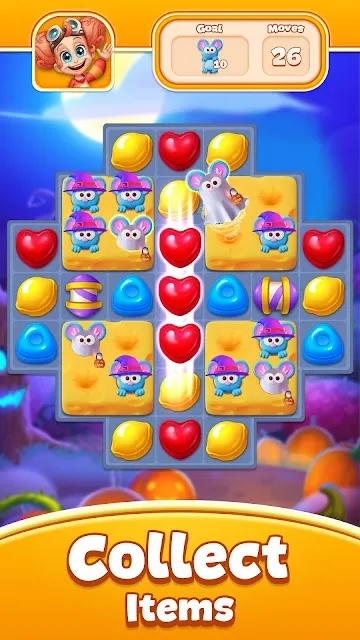
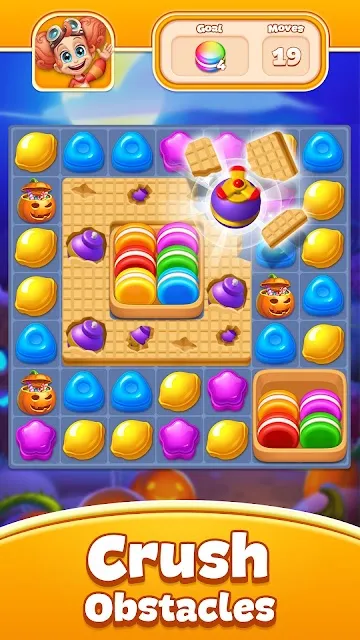
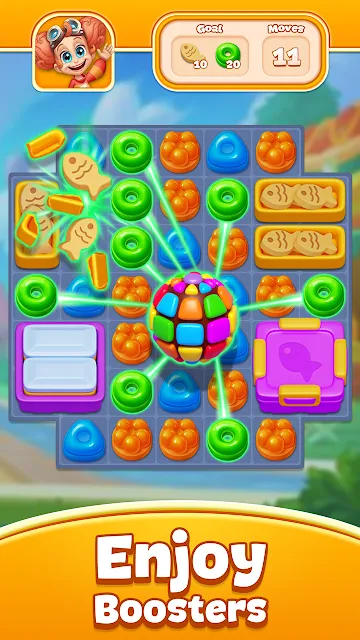
Candy Pop Story : Match 3, by Gamoper
Open the listing on Google Play
Nothing is downloaded or installed from this site. Price, taxes and any fees are shown on Google Play at the next step, and the date above records when these labels were last read from here.
Write to us
[email protected]Email is the only contact channel on this site. There are no forms, no newsletter and no data collection — you write, and the reply goes to the address you wrote from and nowhere else.